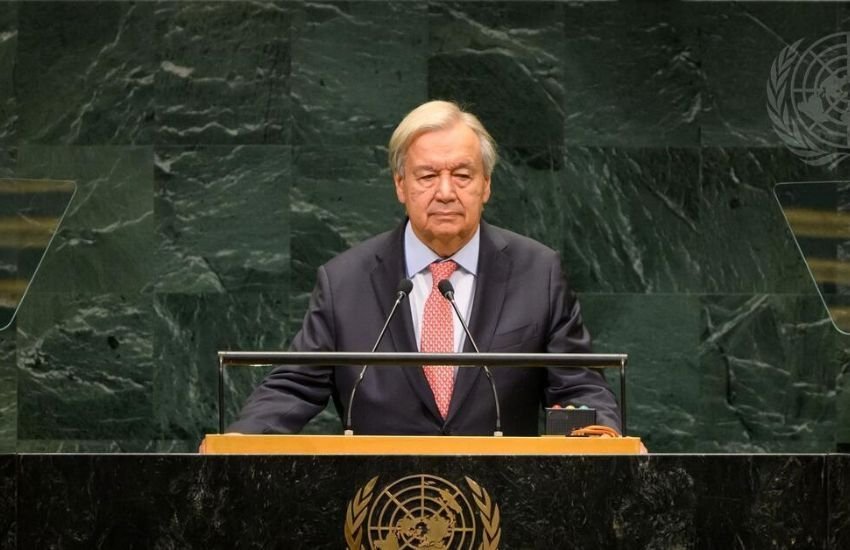
Humanity faces four defining test of power—around war or peace, inequality, climate change and AI—that will determine whether the world moves towards a new era of cooperation or deeper divisions, UN chief warned the General Assembly.
- UN chief urges binding international cooperation on AI governance, warning that life-and-death decisions must never be handed to machines
- Calls for Security Council reform, highlighting the continued “indefensible” absence of permanent African representation
- For the first time in its history, UN has achieved full gender parity across senior leadership and staff
With roughly 100 days remaining in his term as UN Secretary-General, António Guterres delivered a wide-ranging speech that framed the world’s most pressing crises not as isolated problems, but as different expressions of the same underlying struggle over how power is exercised and by whom.
“The greatest power is not the power to dominate. It is the power to build a future that works for everyone,” he said, presenting his annual report of the Organization.
Describing a decade of eroding international norms – from civilians targeted in war, and humanitarian workers killed, to international law “cast aside” and fraying trust between nations – he said power itself is being fundamentally reshaped in three ways:
- Emergence of new State powers
- Significant transfer of authority from governments to private corporations and individuals
- Growing role of AI and autonomous weapons in decisions once reserved for humans
“The faultlines in our world are widening,” he said. “Cracks have become canyons.”
Rather than accepting fragmentation as inevitable, he called for galvanizing cooperation and a truly global network built on interdependence and shared rules while warning against sliding into rival blocs with separate economic and security systems, a scenario he has termed in recent years the Great Fracture.
On climate change, Mr. Guterres said the crisis is the “most profound intergenerational power imbalance”, warning of a near-certain breach of the 1.5°C threshold.
Calling for polluters to “pay” and for developed nations to triple adaptation funding, he pointed out that major oil companies are reaping substantial profits since Russia’s invasion of Ukraine while global adaptation finance for developing countries remains a fraction of that sum.
Turning to AI, the Secretary-General warned that power is increasingly concentrated in data, computing capacity and algorithms, advancing faster than humanity’s capacity to govern it.
“The danger is not technology,” he said. “The danger is technology without accountability.”
Outlaw killer robots
Guard rails on AI must be built, the UN chief said, adding that children must never become the test-subjects for unregulated systems.
“Life-and-death decisions must never be surrendered to machines,” he warned. “Killer robots must have no place in our future.”
To address this, he called for a multilateral AI risk management framework with independent oversight, stating firmly that children must never become test subjects for unregulated systems and that life-and-death decisions must never be surrendered to machines.