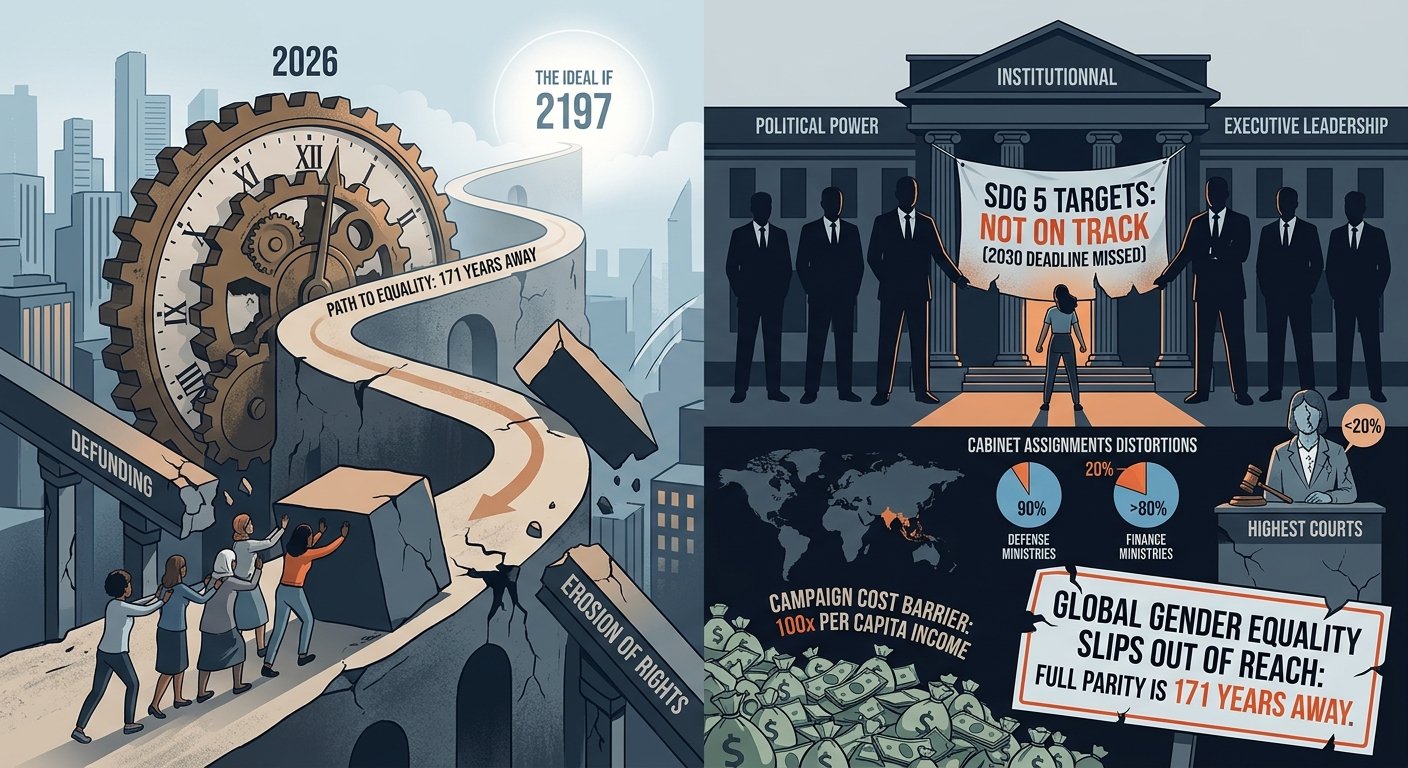
The Gender Snapshot 2026—jointly published by UN Women and the United Nations Department of Economic and Social Affairs (UN DESA)—presents a bleak evaluation of global progress. Strikingly, not a single target under Sustainable Development Goal 5 (SDG 5), which sets out to achieve gender equality, is on track to be met by the initial 2030 deadline.
The stalled goals encompass fundamental rights and protection mechanisms, including ending systemic discrimination, curbing gender-based violence, eliminating harmful practices such as forced marriage and female genital mutilation, ensuring women’s full political participation, and guaranteeing equal economic and property rights.
Political Power Remains Concentrated Among Men
A primary driver of the persistent gender gap is the continued exclusion of women from major political and civic leadership roles. According to the report:
- Executive Leadership: Six out of seven countries globally are currently led by men.
- Campaign Barriers: In many nations, the financial capital required to run for public office can exceed 100 times a country’s average per capita income, pricing out prospective female candidates before campaigns begin.
- Targeted Harassment: In select countries, up to eight out of 10 women running for public office endure targeted violence in public life.
- Cabinet Assignment Distortions: Women who enter government are consistently steered away from top security and economic portfolios. Men hold close to nine out of 10 defense ministry appointments and more than eight out of 10 finance portfolios globally.
Beyond public governance, women represent just 6 percent of corporate CEOs globally and preside over fewer than 20 percent of highest courts. The UN stresses that this structural imbalance directly threatens democratic integrity, as no nation can legitimately uphold human rights while half its population lacks equal representation in decision-making bodies.