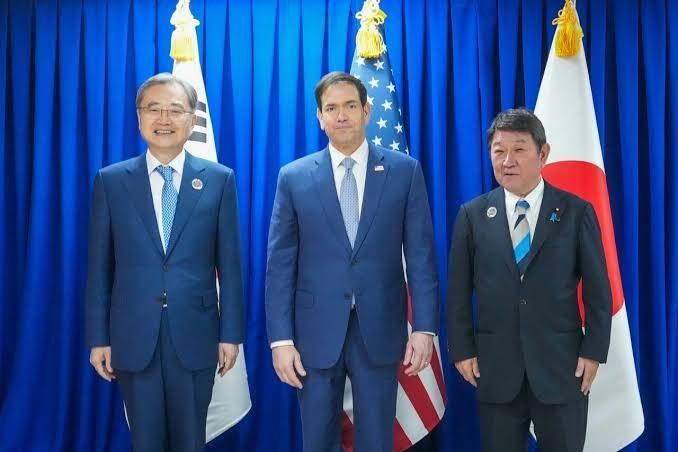
Manila, Philippines — U.S. Secretary of State Marco Rubio met with South Korean Foreign Minister Cho Hyun and Japanese Foreign Minister Motegi Toshimitsu on the sidelines of the ASEAN Foreign Ministers’ Meetings in Manila, reaffirming the three countries’ commitment to strengthening regional security, economic resilience, and strategic cooperation across the Indo-Pacific.
According to a statement attributed to U.S. State Department Spokesperson Tommy Pigott, the three diplomats emphasized closer collaboration with ASEAN on shared priorities, including defense cooperation, maritime security, energy security, cybersecurity, and the promotion of peace and stability throughout Southeast Asia and the wider Indo-Pacific region.
The ministers also agreed to intensify efforts against transnational criminal organizations, particularly networks operating scam centers that have defrauded and endangered people across the region. They pledged to expand trilateral discussions on Arctic issues, citing the region’s growing strategic significance, while reaffirming their commitment to freedom of navigation, maritime security, and continued defense cooperation.
On North Korea, the officials reiterated their unified stance on the complete denuclearization of the Democratic People’s Republic of Korea (DPRK). They also committed to enhancing coordination to counter Pyongyang’s cyber threats and illicit activities and called for the immediate resolution of the longstanding abductions issue.
The meeting also addressed cross-strait stability, with the three ministers underscoring the importance of maintaining peace and stability across the Taiwan Strait. They further expressed concern over China’s recent intercontinental ballistic missile launch into the Pacific Ocean, noting what they described as insufficient prior notification of the test.
In the area of energy cooperation, the ministers discussed implementing the trilateral Memorandum of Cooperation on Small Modular Reactor (SMR) deployments in third countries, which was signed in Ankara. They agreed to begin deployment efforts in the Indo-Pacific as part of broader initiatives to promote energy diversification and technological cooperation.
The three sides also highlighted the importance of economic security, reaffirming their opposition to economic coercion and the weaponization of supply chains. They pledged to work together to diversify critical supply chains, reduce strategic vulnerabilities, and strengthen cooperation on trusted technologies.
The meeting underscored the growing strategic alignment among the United States, South Korea, and Japan as they seek to deepen cooperation on regional security, emerging technologies, energy, and economic resilience amid evolving geopolitical challenges in the Indo-Pacific.