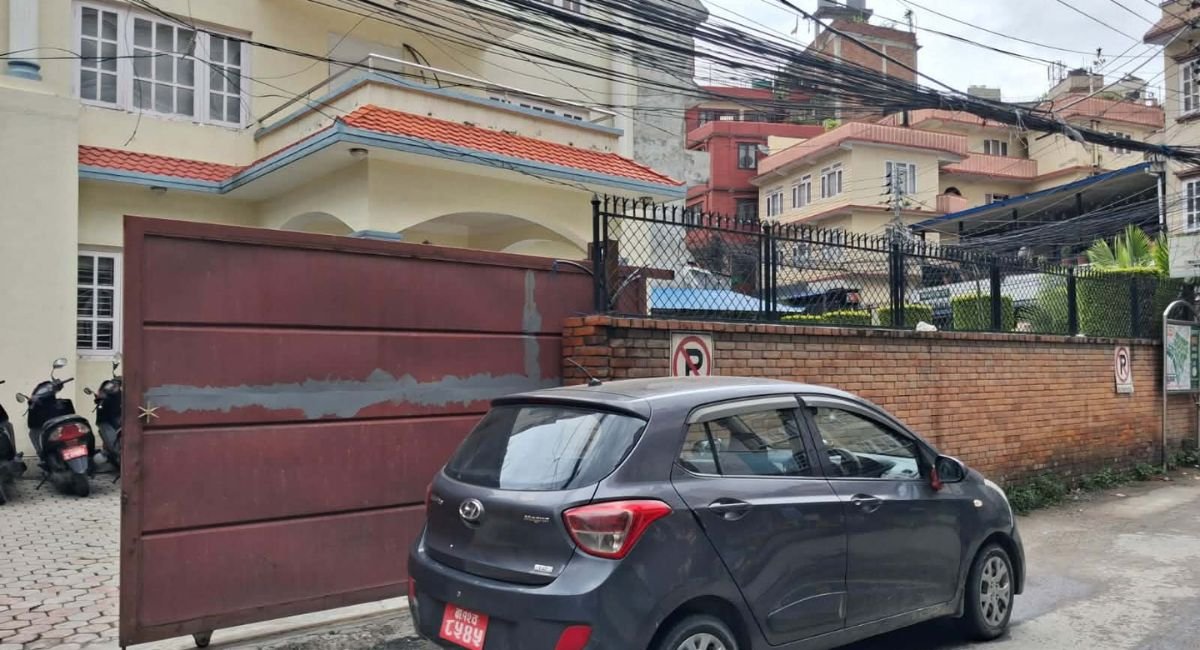
Kathmandu, Monday — In a bizarre and troubling incident early Monday morning, individuals who were initially unidentified—but have since been identified by investigators—parked luxury vehicles to deliberately block the entrances of major media institutions and the residence of a prominent political leader in the Kathmandu Valley.
The coordinated blockade targeted the offices of Kantipur Publications and Onlinekhabar, as well as the residence of Nepali Congress President Gagan Kumar Thapa. The strategically parked vehicles completely obstructed vehicular access to and from these locations for several hours before law enforcement authorities intervened and removed them.
The incident has raised serious concerns over the identity and motives of those involved. Its timing has led media organizations and independent observers to suspect a more deliberate attempt at intimidation.
The blockade comes just days after the tragic self-immolation of ride-sharing driver Ganesh Nepali, who set himself on fire after being fined by municipal police. In the aftermath of the incident, several mainstream media outlets had published critical reports questioning the state’s handling of the case.
Responding to Monday’s blockade, the Federation of Nepalese Journalists (FNJ), along with several media organizations, issued a joint statement describing the incident as a “new playbook adopted to terrorize the press” and suppress critical reporting. Although some initial speculation suggested the vehicles had been parked as an unusual protest highlighting Kathmandu’s chronic parking problems, the media fraternity concluded that the incident appeared to be an act of psychological intimidation.
It has been revealed that one of the luxury vehicles used in the blockade is registered to a senior member of the ruling Rastriya Swatantra Party (RSP) who had recently joined the party. Traffic Police have since towed the vehicles and launched a full-scale investigation. Authorities say they are closing in on those responsible and expect to release a detailed investigation report shortly.
Despite the involvement of a vehicle linked to one of its members, the RSP moved swiftly to distance itself from the incident. In a statement issued by General Secretary Bipin Kumar Acharya, the party strongly condemned the blockade, describing free and fearless journalism as the “lifeblood of democracy.”
“The Rastriya Swatantra Party has always remained committed to protecting press freedom. Therefore, the party strongly condemns any such actions, or any similar acts, intended to intimidate the press,” the statement said.
The party further characterized the blockade as a direct assault on democratic values and an attempt to exert psychological pressure on the fourth estate. It called for an impartial investigation, prompt legal action against those responsible regardless of their political affiliation, and concrete measures to ensure the physical and psychological safety of journalists and media institutions.
Major political parties, press organizations, and civil society groups have echoed these concerns, warning that such incidents set a dangerous precedent for Nepal’s democratic system and the freedom of the press. They have urged authorities to conduct a transparent investigation and hold those responsible accountable under the law.