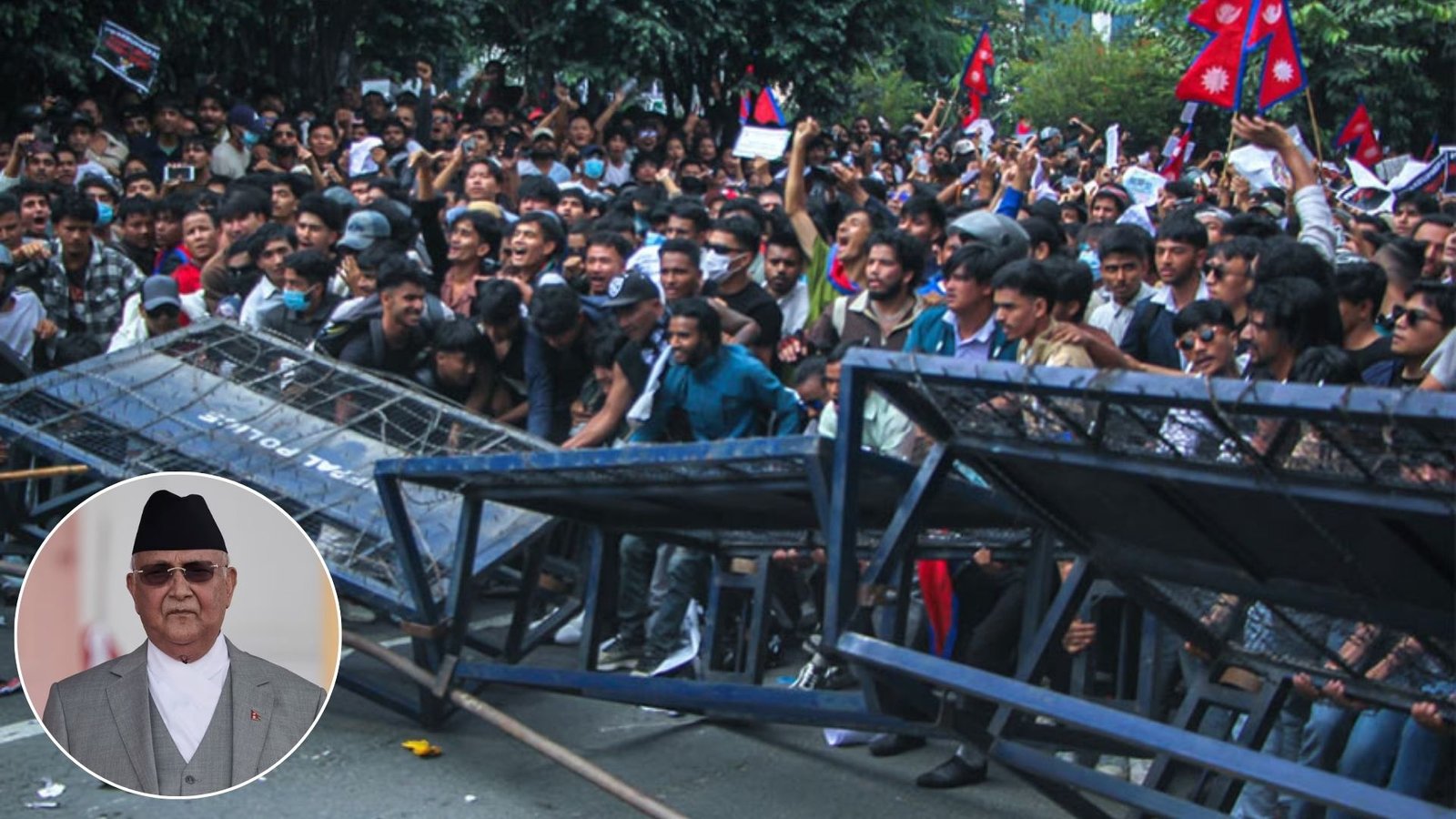
Kathmandu– An investigation panel formed to examine the September 8-9 protests has recommended that then-Prime Minister KP Sharma Oli, Home Minister Ramesh Lekhak, and Nepal Police Chief Chandra Kishwor Khapung be held accountable for the deaths of protesters, most of whom were college students. The Sushila Karki-led government has decided to make the report public after parts of it were leaked to the media.
The Karki-led government had formed a panel headed by Gauri Bahadur Karki, which submitted its report last week. The onus now lies on the new government, led by Balendra Shah, to implement the report’s recommendations.
The panel has recommended investigating the officials under Section 181 of the Muluki Criminal Code, 2018. This section states that “no one shall cause the death of another through negligent acts.” If a death occurs due to such negligence, the law provides for imprisonment ranging from three to ten years and a fine of NPR 30,000 to NPR 100,000. Additionally, the commission has recommended taking action against dozens of government officials for failing to fulfill their duties.
According to the report, despite being informed about the growing security threats, the Prime Minister did not take timely initiatives to prevent casualties. The panel noted that if military and police coordination had been effective, the number of deaths and injuries could have been significantly reduced.
The report emphasizes that Nepal, while having a parliamentary system, operates effectively as a Prime Ministerial system. Even when gunfire continued for nearly four hours around the Parliament building, resulting in several deaths and hundreds of injuries, it was the Prime Minister’s responsibility—as head of government—to ensure the protection of all citizens. The failure of responsible officials to act, and the Prime Minister’s inability to prevent further loss of life, represents a major institutional weakness, according to the report.
The commission also raised questions about the role of the Nepal Army during the protests. While army personnel were deployed at key locations such as Singha Durbar and Sheetal Niwas, the report notes that the army did not appear to carry out its duty to protect these sensitive sites. Commanders stationed at Singha Durbar, the Presidential residence (Sheetal Niwas), the Federal Parliament building in Baneshwor, and the Prime Minister’s residence in Baluwatar reportedly failed to fulfill their responsibilities.
It was also revealed that Nepal Army Chief Ashok Raj Sigdel pressured Prime Minister Oli to resign on the morning of September 9. In his statement to the commission, the Army Chief said he had informed the Prime Minister that the army was fully prepared to manage the situation following the resignation.
The report highlights systemic lapses in intelligence gathering, inter-agency coordination, and preventive measures, warning that future incidents could escalate without reforms in political and security leadership. It points out that security agencies had insufficient information regarding the preparations made by protest organizers.
The National Investigation Department, tasked with intelligence collection, failed to gather adequate information. Similarly, coordination among the Nepal Police, Armed Police Force, and Nepal Army was found to be lacking.
To strengthen Nepal’s security apparatus, the commission has recommended conducting coordinated training programs with the security agencies of India and China. “To enhance the effectiveness of security agencies, diplomatic efforts should be made to conduct coordinated training programs with the security agencies of the two neighboring countries, India and China,” the report states.
The commission also highlighted the role of online platforms, particularly Discord, in organizing the protests. Groups such as “Youth Against Corruption” and “Yuva Hub” facilitated coordination, decision-making, and political endorsements, including the virtual selection of Sushila Karki as Prime Minister. While the District Administration Office prepared security plans for peaceful rallies, messages promoting violence and Molotov cocktails circulated freely online, largely unchecked by security agencies.